Refining Expertise: Diagnosis vs. Association
- Peter Middleton
- May 13
- 5 min read

The Label That Belongs To Us
I’ve spent a lot of time lately sitting in rooms where people talk about me while I’m right there. They use big words, clinical terms, and "management strategies" to describe my own life. In these spaces, you’ll often hear the phrase expert by experience.
It’s a nice sentiment, isn’t it? It’s meant to signal that the person being discussed actually has a seat at the table.
But often, in dementia circles, "Expert by Experience" becomes a bit of a catch-all. It's frequently used to describe family members or spouses who've cared for someone.
While their input is important, it’s fundamentally different from what you go through every day.
And it’s a trend that’s been bothering me. I see this title being shared more and more. It’s being handed out to carers, partners, and family members.
While I have nothing but love and respect for the people supporting us, we need to be clear about one thing: the experience of dementia belongs to the person with the diagnosis.
Understanding the Difference
There is no doubt that being a carer is a monumental task. It’s exhausting, emotional, and requires a specific kind of expertise.
But it is a service expertise. It’s an outside-in perspective.
When you have young-onset dementia, your world isn't just changing; it’s being rewritten from the inside out. My "expertise" isn’t about managing a schedule or navigating a healthcare system. It’s about:
The strange, buzzing static that fills my head when too many people talk at once.
The grief of feeling a word dissolve on my tongue before I can speak it.
The physical sensation of my internal map losing its north star.
A carer sees the symptoms; I live the reality.
You can watch someone walk through a storm, but you aren't the one getting wet.
Why the Distinction Matters
You might think I’m being pedantic. Does a title really matter? I believe it does, for a few vital reasons:
Preserving Agency: When we dilute the term, we risk drowning out the very voices that are already struggling to be heard. If a carer is considered an "expert by experience," their interpretation of my life might be taken as more "reliable" than my own words because they aren't "impaired." That’s a dangerous slope.
Authentic Research: If a study or a policy board wants to understand what it feels like to lose your cognitive grip in your 40s or 50s, a spouse cannot answer that. They can tell you how it affects the mortgage or the marriage, but they cannot tell you how the neurons feel when they misfire.
Respecting the Burden: Giving carers their own space is actually more respectful. They have their own unique challenges, but calling them "experts by experience" in dementia confuses their struggle with our identity.
"A carer sees the symptoms; I live the reality. You can watch someone walk through a storm, but you aren't the one getting wet."
A Seat at the Table
I’m not asking for carers to be excluded from the conversation. We need them. Their insights into the care system are invaluable. But we should call them what they are: experts by support or partners in care.
The term "expert by experience" should be a protected space. It should be the one area where the person with the diagnosis is the ultimate authority.
My brain is the laboratory. My life is the evidence.
Please don’t take the one thing I still own and give it to someone else, no matter how much they love me.
A Solution?
While "Expert by Experience" is inclusive, its vagueness can sometimes be a drawback. It can refer to a one-time event, a long-term condition, or even a specific social situation.
By grouping everyone under one umbrella, we risk losing the specific technical and emotional nuances that different people bring to the table.
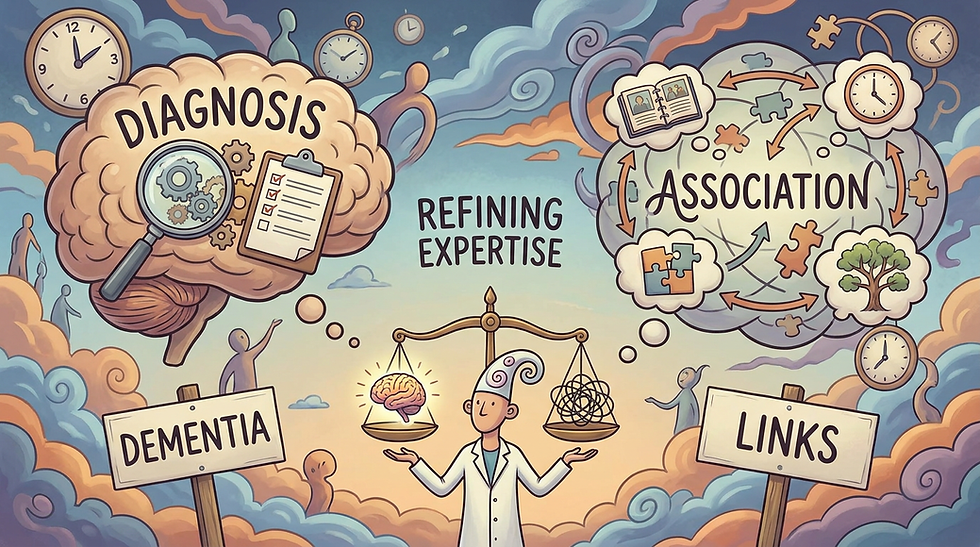
Therefore, I propose that we adopt two more specific labels:
Expert by Diagnosis
Expert by Association.
Expert by Diagnosis: The Internal View
Expert by Diagnosis puts the focus squarely back on ME. It acknowledges that you I a unique, internal understanding of what it’s like to navigate the world as my brain changes.
I’m not just "experienced" in the sense that I’ve seen it happen; I’m the primary source of truth for the symptoms, the frustrations, and the successes.
Precision: It acknowledges my direct biological or psychological reality.
Authority: It grants me individual "ownership" over the narrative of my own body and mind.
Systemic Insight: It allows me to pinpoint exactly where a clinical pathway fails or where a specific symptom is misunderstood by professionals.
Expert by Association: The External Lens
We often forget the people standing next to the person with the diagnosis. Carers, family members, and close friends possess a completely different yet equally vital form of expertise.
Systemic Navigation: They often see the "gaps" in the system that the patient might be too unwell to notice. They deal with the admin, the pharmacy runs, and the social services.
Long-term Observation: They provide a longitudinal view. They know what the person was like before, during, and after a crisis, offering a perspective that a 20-minute clinical appointment never could.
Support Expertise: They understand the "infrastructure of care" better than anyone.
Comparing the Approaches
Term | Who it Covers | Primary Contribution |
Expert by Experience | Everyone involved. | A broad, lived perspective on a situation. |
Expert by Diagnosis | The individual with the condition. | Direct insight into symptoms, treatment effects, and personal identity. |
Expert by Association | Carers, family, and friends. | Insight into the care system, long-term support, and external impact. |
Why this matters in a room full of "Experts"
If you've ever been to a support group or a medical meeting, you might have noticed that carers' voices can sometimes take over. They are often more "vocal" because they aren't dealing with the same cognitive load.
When we use these two distinct terms, it creates a "reserved seat" for you. It reminds everyone that:
The internal reality (Diagnosis) cannot be spoken for by anyone else.
The external support (Association) is a separate, secondary layer of information.
It prevents the two perspectives from being blurred into a single, messy bucket of "experience."
It ensures that when a researcher or a doctor wants to know how a specific medication feels or how a memory aid actually works in practice, they know they must speak to the Expert by Diagnosis.
Conclusion
I know that this blog is controversial. I know that it will upset some Carers. But I also know that it is a conversation that needs to be had.
EVERYONE’S contribution is vital to building a complete picture, but in my humble opinion, we need to get the labels right to avoid ambiguity and recognise uniqueness.
Please let my know your thoughts and opinions.

Comments