Why Dementia Charities Don’t Represent Me When They Campaign: A Perspective from Lived Experience

Introduction
Campaigning is supposed to be about voice; about amplifying the people most affected, about speaking truth to power, about shaping change that actually improves lives. Yet as someone living with dementia, I’ve learned a difficult truth: many dementia charities don’t represent me when they campaign. They speak about dementia, around dementia, and sometimes even over people with dementia, but rarely with us, and almost never for us in a way that feels true, accurate, or empowering.
This isn’t a criticism of the individuals who work within these organisations. Many are compassionate, dedicated, and genuinely trying to make a difference. But the system, the structure, and the culture of large dementia charities often create a gap; a gap between what they say and what we experience, between their priorities and ours, between their campaigns and our realities.
This blog is about that gap. It’s about why it exists, how it affects people living with dementia, and why it matters. Most importantly, it’s about why our voices - the voices belonging to those actually living with dementia - must be at the centre of any campaign that claims to represent us.
Charities Often Speak About Us, Not With Us
One of the most painful experiences of living with dementia is feeling invisible. You’re talked about in meetings, referenced in reports, and used as a justification for funding, yet rarely invited to frame the narrative.
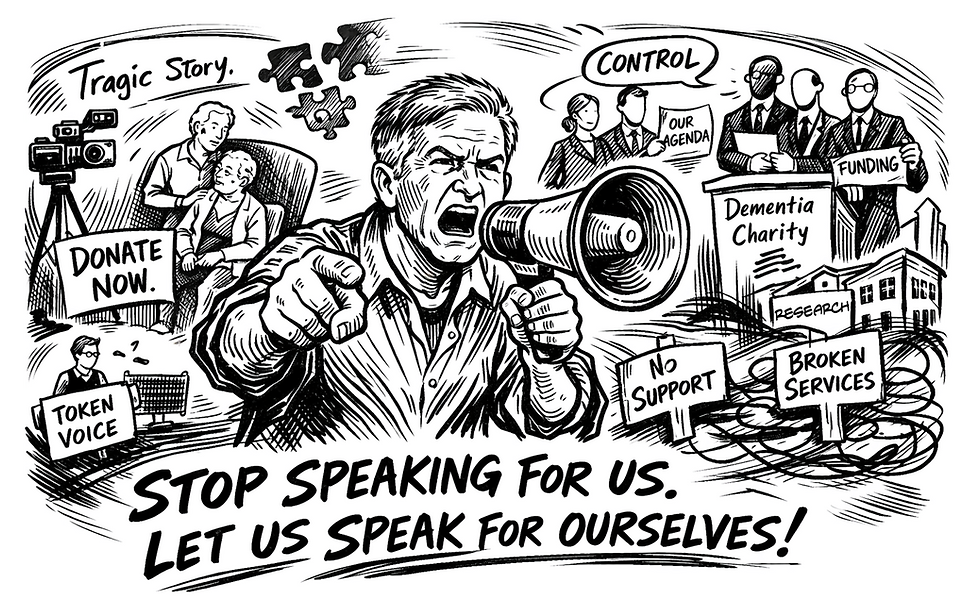
Large dementia charities often fall into this trap. Their campaigns are built on assumptions, generalisations, and organisational priorities rather than lived experience. They may consult people with dementia occasionally, but that doesn’t constitute representation. A single focus group doesn’t equal partnership.
A tokenistic advisory panel doesn’t equal co‑production.
When charities speak about dementia without us, they inevitably misrepresent us. They simplify our experiences. They flatten our diversity. They reduce us to symptoms, burdens, or inspirational stories. They create campaigns that feel polished but hollow. Campaigns that look good on paper but don’t reflect the messy, complex, human reality of living with dementia.
Representation requires presence. It requires listening. It requires humility. It requires sharing power. Without those things, a campaign may be loud, but it will not be truthful.
Charities Often Prioritise Their Brand Over Our Reality
Charities are organisations. Organisations need funding. Funding requires visibility, emotional impact, and public support. This creates pressure to craft stories that appeal to donors, politicians, and the media.
But the accounts that receive funding are not always the accounts that reflect lived experience.
Many dementia campaigns rely on:
Overly tragic portrayals of dementia
Exaggerated claims about “the fight” or “the battle”
Theatrical language designed to provoke fear or pity
Simplified stories that fit a marketing strategy rather than reality
These accounts may raise money, but they also reinforce stigma. They make dementia seem hopeless, terrifying, and dehumanising. They erase the possibility of joy, agency, humour, resilience, and community, all of which are part of real life with dementia.
When charities prioritise brand over truth, they stop representing us. They represent their organisational needs instead.
Campaigns Frequently Ignore the Diversity of Dementia
Dementia is not one condition. It is not one experience. It is not one story.
People living with dementia vary in:
Age
Type of dementia
Symptoms
Progression
Culture
Identity
Support networks
Socioeconomic background
Personal values
Communication style
Priorities
Yet many campaigns treat dementia as a single, uniform experience. They focus on one narrative, often the one that is easiest to communicate or most emotionally impactful.
This erases people with rare dementias.
It erases younger people with dementia.
It erases people whose symptoms don’t fit the stereotype.
It erases people who are still active, articulate, and engaged.
It erases people who don’t want to be portrayed as victims.
It erases people who want to be seen as partners, not patients.
A campaign that only represents one type of dementia does not represent dementia. It represents a fraction of it, and often not the one that needs the most advocacy.
Charities Often Campaign For Us Without Asking What We Want
One of the most frustrating aspects of dementia campaigning is the assumption that charities already know what we need. They decide the priorities. They decide the messaging. They decide the goals. They decide what “people with dementia” want, without actually asking us.
This leads to campaigns that focus on organisational priorities rather than lived priorities, political agendas instead of personal realities, funding opportunities rather than community needs, and visibility rather than impact.
For example, a charity may campaign for increased diagnosis rates (a worthy goal in many cases) but ignore the fact that many people struggle far more with post‑diagnostic support than with diagnosis itself.
Or they may campaign for more research funding (again, important) but neglect the immediate needs of people living with dementia today, such as accessible services, integrated care, and community support.
When charities decide what we need without asking us, they stop representing us. They represent their own assumptions instead.
Lived Experience Is Often Used Symbolically, Not Substantively
Many dementia charities proudly state that they “include lived experience” in their work. But inclusion is not the same as influence.
Too often, people with dementia are invited to:
Share a story
Appear in a video
Attend a meeting
Provide a quote
Give a testimonial
These contributions are valuable, but they’re often symbolic. They’re used to humanise a campaign, not shape it. They’re used to add emotional weight, not strategic direction. They’re used to demonstrate inclusivity, not enact it.
Real representation means:
Co‑designing campaigns
Co‑writing messaging
Co‑setting priorities
Co‑leading advocacy
Co‑deciding strategy
Co‑owning outcomes
Anything less is tokenism, even if well‑intentioned.
Charities Often Reinforce Stigma Without Realising It
Stigma is one of the biggest barriers faced by people living with dementia. It affects how we are treated, how we are perceived, how we are supported, and how we see ourselves.
Yet many dementia campaigns unintentionally reinforce stigma by:
Portraying dementia as a tragedy
Centring solely on decline
Using language of loss, burden, or hopelessness
Emphasising fear rather than understanding
Presenting people with dementia as passive recipients of care
Ignoring our strengths, abilities, and contributions
These accounts may evoke sympathy, but they also generate fear. They make people afraid of dementia. They make people afraid of us. They make people assume we are incapable, incompetent, or childlike.
A campaign that reinforces stigma cannot represent us. It harms us.
Charities Often Fail to Challenge Systemic Issues
Many dementia campaigns focus on awareness, fundraising, or general advocacy. These are important, but they often avoid the deeper, more uncomfortable issues; the issues that actually shape our lives.
For example:
Fragmented services
Lack of integration between health and social care
Inconsistent post‑diagnostic support
Inaccessible pathways
Poor communication between providers
Limited community resources
Inequitable access to care
Lack of training for professionals
Bureaucratic barriers
Underfunded local services
These issues require systemic change. They require collaboration across organisations. They require challenging entrenched structures. They require listening to lived experience.
But systemic change is difficult, slow, and politically sensitive. It doesn’t fit neatly into a marketing campaign. It doesn’t produce quick wins. It doesn’t always attract donors.
So charities often avoid it, or address it superficially.
A campaign that avoids systemic issues cannot represent us. It merely represents convenience.
Charities Often Don’t Understand What Empowerment Really Means
Empowerment isn’t about telling people with dementia that they are “brave” or “inspiring.” It isn’t about giving us a platform for a single event. It isn’t about featuring us in a video.
Empowerment means:
Respecting our autonomy
Valuing our expertise
Trusting our judgement
Sharing decision‑making power
Supporting our leadership
Recognising our agency
Acknowledging our diversity
Listening deeply
Acting on what we say
Many dementia charities talk about empowerment, but few practise it. They create campaigns that are emotionally powerful but structurally disempowering. They give us visibility yet not influence. They give us voice but not authority.
A campaign that doesn’t empower us can’t represent us.
Charities Often Don’t See Us as Experts
People living with dementia are experts in dementia. We understand the condition in ways that no textbook, no training course, and no professional experience can replicate.
Yet many charities treat lived experience as secondary, as something to consult, not something to centre. They rely on professionals, researchers, and organisational leaders to shape campaigns, while lived experience is used to “add authenticity.”
This is backwards.
Lived experience should be the foundation of any dementia campaign. Professionals should support, not lead. Organisations should facilitate, not dictate. Researchers should inform, not dominate.
A campaign that doesn’t recognise us as experts can’t represent us.
Charities Often Don’t Challenge Their Own Power
Ultimately, the biggest barrier to representation is power.
Large dementia charities hold:
Financial power
Political power
Media power
Organisational power
Narrative power
Cultural power
People living with dementia often hold none of these. We rely on others to amplify our voices. We rely on organisations to create space for us. We rely on systems to include us.
But power is rarely shared voluntarily. It must be intentionally redistributed. It must be consciously shared. It must be structurally embedded.
Many charities aren’t yet ready to do this. They want to represent us, but they don’t want to relinquish control. They want to speak for us, but they don’t want to share the microphone. They want to lead campaigns, but they don’t want to co‑lead them.
A campaign that does not share power cannot represent us.
So What Does Real Representation Look Like?
Real representation means:
Co‑production, not consultation
Shared leadership, not symbolic involvement
Lived experience at the centre, not at the edges
Truthful narratives , not marketing narratives
Diverse voices, not single stories
Empowerment, not pity
Systemic change, not superficial awareness
Authenticity, not performance
Partnership, not hierarchy
It means campaigns that reflect our reality, not the version of reality that fits an organisational strategy.
It means seeing people with dementia as partners, not props.
It means recognising that representation isn’t a slogan. It’s a structure.
A Final Word: We Don’t Need Charities to Speak for Us — We Need Them to Listen
I’m not asking dementia charities to stop campaigning. I’m asking them to start listening deeply, consistently, and humbly. I’m asking them to recognise that lived experience isn’t an accessory. It’s the foundation of meaningful change.
If a campaign does not represent us, it cannot help us. If a campaign does not include us, it cannot empower us. If a campaign does not reflect our reality, it cannot improve our reality.
We do not need charities to be our voice. We need them to make space for our voice.
We are here.
We are willing.
We are capable.
We are experts.
We are partners.
We are not invisible.
And we deserve campaigns that represent us, not ones that simply reference us.


The charities show things that don’t exist in real life and are untrue ,because you can live well with Dementia and I am proof!