Whose Charity Is It Anyway? Putting Lived Experience Back at the Helm


If you walk into the head office of any major UK dementia charity, you’ll find glossy brochures, earnest mission statements, and passionate talk about "the voice of the community."
But take a seat in the boardroom, look around the table, and a very different picture emerges.
Where are the people actually living with a diagnosis?
Too often, lived experience isn’t front and centre; it’s barely in the room. Instead, board seats, advisory panels, and steering committees are packed to the rafters with academics, clinical researchers, career executives, and policy wonks. While their professional expertise has its place, it has led to a worrying distortion of priorities.
Charities that were founded to support people with dementia have increasingly become cheerleaders for the priorities of academia and the pharmaceutical industry, rather than champions for the daily realities we face.
Nothing illustrates this disconnect better than the recent storm surrounding Lecanemab and Donanemab. When the National Institute for Health and Care Excellence (NICE) decided not to recommend these new amyloid-targeting treatments for routine NHS funding, parts of the charity sector erupted in performative outrage. We were told this was a "devastating blow," a catastrophic setback that robbed thousands of hope.
Yet if you talk to the grassroots dementia community—the people actually navigating this condition every single day—the reaction couldn't be more different. For most of us, NICE’s decision wasn’t devastating; it was common sense, and roundly welcomed.
We aren't blind to what these drugs actually offer. In real terms, we’re talking about marginal statistical differences on a memory score over eighteen months—differences so tiny they barely translate into noticeable improvements in everyday quality of life. In exchange for that negligible gain, patients face regular, disruptive hospital infusions, constant brain scans, and the very real, terrifying risks of brain swelling and micro-bleeds (ARIA).
Why on earth are some of our largest charities campaigning so fiercely for the rapid NHS rollout of treatments at such an early, precarious stage of development?
Who does that frantic lobbying really serve? It certainly suits pharmaceutical giants eager to unlock public healthcare budgets, and it gives academic institutions a shiny new research horizon. But it doesn't solve the urgent, practical crises facing people living with dementia today.
When you're diagnosed, your world shifts on its axis. You aren't lying awake at night begging for a marginally slower decline in exchange for potential brain haemorrhages. You're asking:
How do I keep my independence and navigate my community safely?
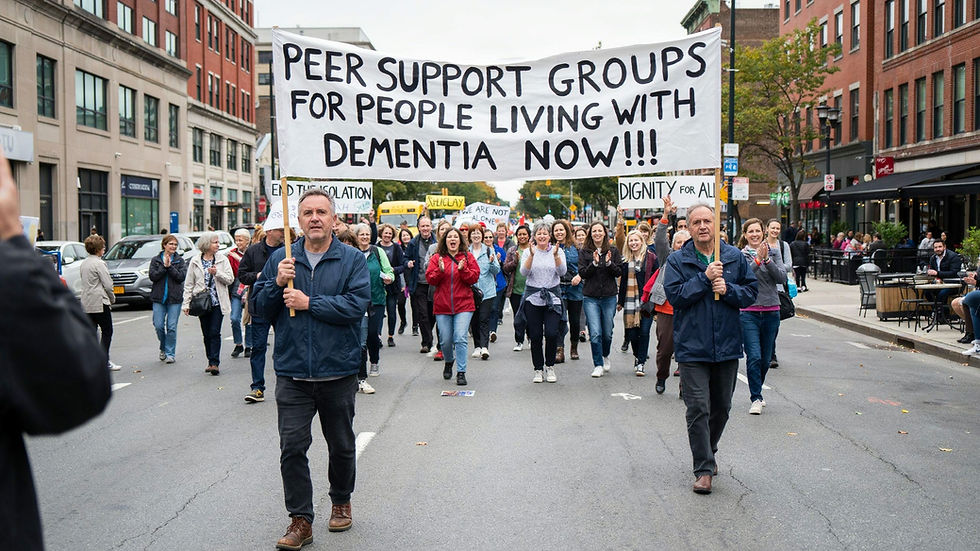
Where can I find genuine peer support with people who understand what I'm going through?
Why is social care so broken, underfunded, and impossible to access?
How do we educate the public so that people with dementia aren't met with pity, fear, or instant dismissal?
These are the battles that matter to us. These are the things we identify as vital. Yet when millions of pounds of public donations are channelled into lobbying for borderline clinical treatments while basic community support and post-diagnostic services crumble, the priorities have gone dreadfully wrong.
UK dementia charities need a hard reminder of their fundamental purpose. You don't exist to boost the prestige of research faculties. You don't exist to pave the way for pharmaceutical profits. You exist to serve our needs.
It’s time to stop treating people with dementia as passive subjects to be studied, pitied, or used as emotional leverage in press releases.
Our voices shouldn't be relegated to tokenistic focus groups or rubber-stamp advisory panels. Lived experience belongs squarely in the boardroom, directing strategy, setting budgets, and determining campaign goals.
Until charities let us lead the conversation about what we actually need, they can't genuinely claim to speak for us.


Well said mate you and I are on the same page