Expert by Experience: Why Global Dementia Services must be built WITH us Not FOR us
- Peter Middleton
- Jun 13
- 4 min read


Introduction
When you get a diagnosis like this before you are sixty-five, you quickly learn that the systems built to support you are often fragmented, outdated, and desperately lacking in consistency.
But as I look beyond my own backyard, I see that this is not just a British problem; it is a global crisis of equity and voice.
What infuriates me most is the wall of patronising assumptions we face the moment we receive our diagnosis.
People in positions of authority and power, whether they are politicians, health executives, or senior managers, look at us and immediately assume our capacity for intelligent thought has evaporated.
They smile, pat us on the head, and confidently decide they know what is best for us.
Let me set the record straight: no amount of book learning, no string of university degrees, and no mountain of theoretical knowledge can ever replace actual lived experience.
Theoretical knowledge is not useless, but it can only ever complement and support our reality; it can never substitute it.
You can study dementia for forty years in a pristine laboratory or university lecture hall, but you will still never understand the precise, daily reality of navigating a world with a changing brain.
Today, I am writing to issue a direct call to action to every single person living with dementia across the globe. It is time for us to challenge these low expectations, stand up, join hands, and drive the international standards we all desperately need
The Global Reality: A Lottery of Care
Dementia does not care where you live, but the global lottery of care certainly does. The scale of our community is staggering, yet the response from world governments is painfully slow.
The Numbers: Over 55 million people worldwide are living with dementia. By 2030, that figure will rise to 78 million; by 2050, it will skyrocket to 139 million. (Dementia Statistics Hub)
The Funding Gap: The global cost of dementia is already over US$1.3 trillion annually, yet funding for actual care and support fails to keep pace. (PMC-NIH)
The Diagnosis Divide: In high-income countries, only 20% to 50% of cases are formally diagnosed. In lower and middle-income countries, the "treatment gap" is an abyss; in places like India, up to 90% of people remain completely undiagnosed, living without any formal support. (Alzheimer's Disease International)
The Policy Failure: According to recent data from Alzheimer's Disease International, only 24% of the world's governments have a funded national dementia plan. While Europe has twenty-three active plans, Africa has absolutely zero. (Dementia Researcher NIHR)
These are not just statistics; they represent millions of human beings being left behind. How can we tolerate a world where your access to a timely diagnosis, post-diagnostic support, or basic rehabilitation depends entirely on your postcode or your country's wealth?
Nothing About Us Without Us: The Power of Co-Creation
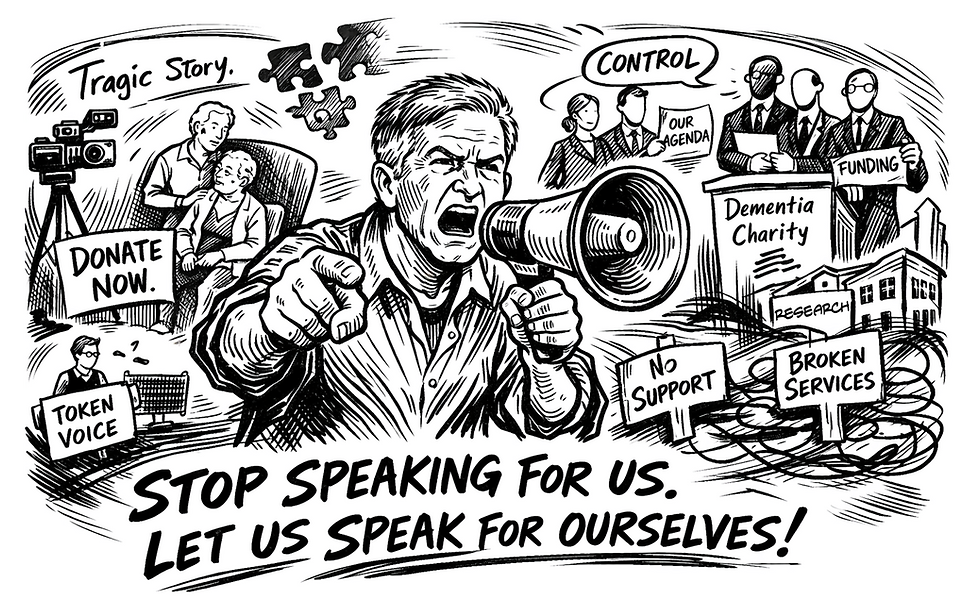
Here is the hard truth. For decades, we have allowed well-meaning academics, large charities, and medical institutions to speak on our behalf. They sit in boardroom meetings, write policy papers, and design services based on what they think we need.
The results? Services that feel sterile, patronising, or completely out of touch with the daily reality of living with a changing brain.
Let me be absolutely clear: While we value allies, allowing others to speak for us means we will NEVER get the services we need and deserve.
To break this cycle, we must champion person-led initiatives that move far beyond traditional engagement. It is time to embrace true co-production and, crucially, co-creation.
While co-production often involves people with lived experience helping to deliver or improve existing systems, co-creation starts much earlier. It means we are there at the blank canvas. We are equal partners from day one, framing the problems, generating the ideas, and designing the solutions from the ground up.
Traditional Care ──> Academics/Charities decide what we need.
Co-Production ──> We help improve and deliver their plans.
Co-Creation ──> WE start with the blank canvas, designing services together.
When an initiative is entirely person-led, the power dynamic shifts completely. We are not just sitting on an advisory panel as a token gesture to tick a bureaucratic box. We are the architects.
We are the true experts by experience. We know exactly what it feels like to navigate the world with cognitive changes, and we know what meaningful support looks like.
By driving co-creation on an international scale, we ensure that global standards are shaped by our actual day-to-day realities, not by theoretical models.
A Clarion Call for Global Unity
We must now look beyond our local support groups and national borders. We need to create an international network of people living with dementia to share best practices and force global standardisation.
If a brilliant model of community support works in Peru, Poland, or Australia, we need to know about it, share it, and demand it everywhere.
This is my invitation to you. Let us come together in a collegiate, non-partisan way.
We must leave politics, organisational rivalries, and regional divisions at the door. We must build a movement that treats every single person with dementia as an absolute equal, whether you live in London, Nairobi, Delhi, or New York.
We have the passion, the insight, and the absolute right to shape our own futures. Let us unite, raise our voices, and build a world where high-quality, person-led dementia services are an international standard, not a luxury.

This is a very powerful and timely piece. It clearly shows how much work still needs to be done to make dementia care fairer, more consistent, and more respectful of the people it is meant to support.
What stands out most is the strong message about lived experience. The article makes a convincing case that people living with dementia should not just be consulted, but should be involved from the very beginning in shaping services and policy. That point comes across well and feels especially important.
I also think the focus on global inequality is very effective. It reminds us that access to diagnosis, support, and proper care should not depend on where someone lives or how much funding their…
Here here mate Iam Definetly IN if we leave it to the people in the know it will never happen